
Insights
Temporary Construction Walls for Healthcare Renovations
Temporary construction walls for healthcare renovations and ICRA containment.
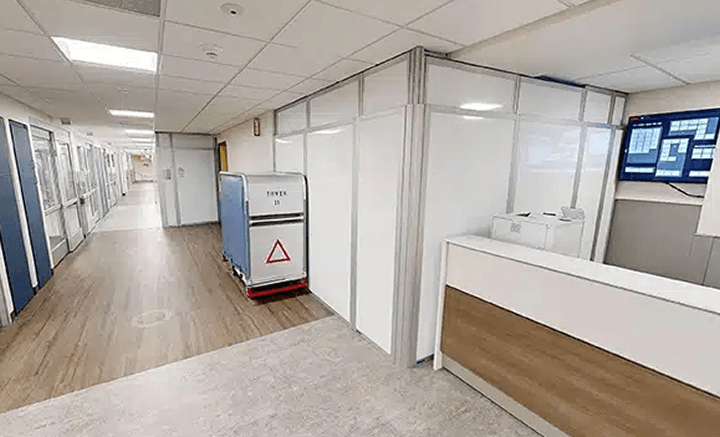
Temporary Construction Walls for Healthcare Renovations: What Contractors Need to Know
Renovating an active hospital or healthcare facility comes with a unique challenge: construction has to move forward without disrupting the people and spaces around it.
Patients still need care. Staff still need access. Corridors may need to remain open. At the same time, dust, debris, noise, and construction traffic have to stay separated from occupied areas.
That is where temporary construction walls become an important part of the project.
For healthcare contractors, modular temporary wall systems can provide a cleaner, faster, and more professional alternative to traditional temporary drywall, especially on phased or occupied renovations.
Why Temporary Walls Matter in Healthcare Construction
In a typical commercial renovation, temporary separation may be mostly about keeping people away from the work area.
In healthcare, containment can be much more important.
Construction activity can generate dust and airborne particles, while hospitals and medical facilities may have patients who are particularly sensitive to environmental conditions. Depending on the project and the facility's infection-control requirements, the containment plan may involve rigid barriers, controlled access, negative air, HEPA filtration, and pressure monitoring.
Temporary construction walls serve as the physical barrier between the active construction zone and the occupied facility.
The wall itself is only one part of a broader containment strategy, but getting that part right can make the rest of the project easier to manage.
Modular Temporary Walls vs. Temporary Drywall
Temporary drywall has been used on construction projects for decades, but it comes with added labor and cleanup.
A typical temporary drywall partition may require framing, hanging board, finishing, painting, and eventual demolition.
Modular temporary walls take a different approach.
The panels arrive as finished components, are installed for the duration of the project, and can then be removed or relocated as construction progresses.
That can offer several advantages on an occupied healthcare project:
- Faster installation and removal
- Less construction debris
- Cleaner appearance in public-facing areas
- Easier relocation during phased work
- Reduced need to repeatedly build and demolish temporary partitions
For projects with several phases, the ability to reposition the same wall system can be especially valuable.
Planning the Containment Before Installation
A successful temporary wall installation starts before the panels arrive.
The project team should consider:
- Total linear footage
- Ceiling height
- Door locations
- Worker access
- Material and debris routes
- Existing egress paths
- Negative-air equipment
- Ventilation requirements
- Project phasing
- Future wall relocations
Healthcare projects can also require anterooms, sealed transitions, or specific access points depending on the project's infection-control plan.
Addressing these details early helps avoid changes after installation and keeps the containment aligned with the construction schedule.
Why Full-Service Temporary Wall Rental Matters
Temporary containment often changes as the project changes.
A wall that works during one phase may need to move when demolition, finishes, or another area of the facility becomes active.
With a full-service temporary wall rental, the contractor does not have to manage the wall system alone.
Trident Walls can assist with:
- Project planning and layout
- Delivery and installation
- Doors and access points
- Wall relocations during phased construction
- Ongoing project support
- Final removal
The goal is to make temporary containment one less scope for the project team to manage.
Temporary Walls Beyond Healthcare
Healthcare is one of the most demanding applications for temporary containment, but modular walls can also be useful in other occupied environments, including:
- Hotels
- Airports
- Corporate offices
- Retail spaces
- Schools and universities
- Data centers
- Commercial renovations
Anywhere construction is happening next to customers, employees, patients, or the public, a professional temporary barrier can help separate the work without making the entire facility feel like a construction site.
Planning a Temporary Wall Project?
If you have an upcoming renovation, involving your temporary wall provider early can help identify potential access, phasing, and containment issues before mobilization.
If you have drawings, a floor plan, or even an approximate wall layout, Trident Walls can help review the project and determine the best temporary containment approach.
Need temporary construction walls for an upcoming project? Contact Trident Walls to discuss your project and request a quote.